
Your mouth produces roughly a liter of saliva every day, and most of us never think twice about it. Saliva is so constant and ordinary that it doesn’t register as something doing important work. But when saliva production drops, the consequences can be severe and often irreversible. Tooth decay, gum disease, oral infections, and accelerated enamel erosion are just a few of the conditions that follow. If you deal with a persistently dry mouth and haven’t connected it to your cavity history, this is the link you’ve been missing.
What Saliva Does to Your Teeth
Saliva is a protective fluid doing multiple jobs simultaneously, and when it’s reduced, several of those jobs simply stop.
According to the National Institute of Dental and Craniofacial Research (NIDCR), saliva moistens and breaks down food, washes away food particles from the teeth and gums, and fights tooth decay through the calcium and phosphate minerals it carries. It also contains antibodies that fight bacterial and viral infections in the mouth and throat. Remove that protective layer, and your teeth are essentially left undefended.
Here’s what changes when saliva is low:
- Acid neutralization stops. Saliva balances the acids produced by oral bacteria. Without it, those acids sit on tooth enamel and begin demineralizing the surface — the first stage of decay.
- Remineralization slows down. Healthy saliva delivers calcium and phosphate ions that actively repair early enamel damage. Without adequate flow, that repair process can’t happen.
- Bacterial populations grow unchecked. Saliva carries antimicrobial proteins that limit harmful bacteria. Reduced flow means those bacteria (Streptococcus mutans, the primary decay-causing organism) multiply faster and produce more acid.
- Food and plaque aren’t removed between meals. Saliva wash helps remove debris. Without it, food residue and plaque accumulate at the gumline and between teeth.
According to the ADA, without adequate salivary flow, tooth decay and various oral infections can develop. That statement understates how quickly things can deteriorate in cases of chronic dry mouth.
If you’ve noticed more cavities than usual or sensitivity that seems to be worsening, finding an online ‘dentist near me’ who takes the time to evaluate the underlying cause is an effective first step.
What Causes Dry Mouth?
The medical term for dry mouth is xerostomia, and its causes range from simple to complex. The Merck Manual notes that approximately 400 prescription medications and many over-the-counter medications cause decreased salivation. It means dry mouth is often a side effect of treating something else entirely.
Medications
Medications are the most common cause of dry mouth. Antihistamines, antidepressants, blood pressure medications, diuretics, antianxiety medications, and bladder-control drugs are the common causes behind dry mouth. If you started experiencing dry mouth around the same time you started a new prescription drug, that connection is worth bringing up with both your doctor and your dentist.
Systemic Conditions
Several chronic conditions directly affect saliva production. Sjögren’s syndrome (an autoimmune disorder) targets the salivary and tear glands, resulting in significant, ongoing dryness. Diabetes is also closely linked to xerostomia: research published in PMC found that elderly patients with diabetes had 3 times higher odds of experiencing dry mouth compared to those without diabetes. HIV/AIDS and some autoimmune diseases can also impair salivary gland function.
Radiation and Chemotherapy
Head and neck radiation therapy is among the most damaging causes of salivary gland damage. Unlike medication-induced dry mouth, which often improves when the medication is changed, radiation damage to the salivary glands can be permanent. Cancer patients and survivors with dry mouth should prioritize preventive dental care.
Habitual and Environmental Causes
Mouth breathing (whether from chronic nasal congestion, snoring, or sleep apnea), caffeine, alcohol, and tobacco all contribute to reduced salivary flow. Dehydration is another overlooked factor in older adults. NIDCR is clear that dry mouth is not a normal part of aging, but the conditions that cause it become more common with age.
The Decay Pattern That Points to Dry Mouth
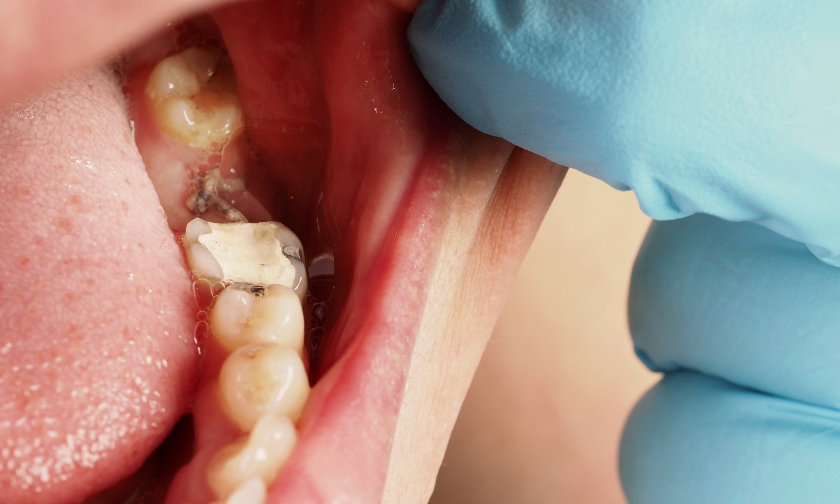
One of the things that makes dry mouth–related decay so distinctive is where and how it appears. Cavities form on the chewing surfaces and between teeth. But when saliva flow is low, decay develops along the gumline and on the smooth surfaces of teeth – areas that usually get self-cleaned with adequate saliva flow.
Dentists also sometimes see rapid, widespread decay across multiple teeth in patients with untreated dry mouth. This pattern, combined with a patient’s reported symptoms, often tells the clinical story before any testing is done.
Other signs that dry mouth has already affected your oral health include:
- Tooth sensitivity that wasn’t there before
- A sticky feeling in the mouth, especially on waking
- Recurring mouth sores or cracked corners of the lips
- Bad breath that doesn’t resolve with brushing
- Difficulty chewing dry foods
Managing Dry Mouth With the Right Dental Support
Treating the underlying cause of dry mouth is the first goal, but in many cases, the cause is a medication you need to stay on or a condition that can’t be fully resolved. That’s where preventive dental care takes center stage.
A dentist in Newton, KS who takes a personalized approach will evaluate your dry mouth as part of your overall oral health picture. At a boutique dental studio focused on small-town personalized care, that means a thorough review of your medical history and medications, a candid conversation about your symptoms, and a prevention plan tailored to your risk level.
The services offered by a modern dentist in Newton, KS, focus on whole-patient care and often include prescription-strength fluoride treatments to strengthen enamel, more frequent professional cleanings to manage plaque buildup, and guidance on staying hydrated.
For patients who avoid dental visits due to anxiety, comfort options during treatment and a gentle, unhurried approach to care make it easier to stay consistent. You can search online for a “gentle dentist near me” to find oral care that can be difficult to get elsewhere. Personalized dental care at a modern dental practice should feel different.
Don’t Let Dry Mouth Quietly Destroy Your Teeth
Dry mouth is a real condition with measurable consequences for your teeth, and those consequences compound over time if nothing is done. The good news is that with attentive professional care and the right home oral care habits, much of the risk is manageable.
If you’re dealing with persistent dryness, increasing sensitivity, or more cavities than you’d expect, schedule a comprehensive exam at Newton Dental Studio. A complete evaluation, along with a review of the causes of your dry mouth, is essential to protect your smile long-term.
People Also Ask
Can dry mouth cause cavities even if I brush and floss regularly?
Yes. Good hygiene helps, but doesn’t replace saliva’s protective functions, like neutralizing acids and remineralizing enamel. Dry mouth may require additional care, such as fluoride treatments and professional cleanings, to prevent cavities.
Are there toothpastes or rinses formulated for dry mouth patients?
Yes, specialized toothpastes and mouthwashes contain enzymes and fluoride to support saliva’s protective role. Avoid alcohol-based products, as they dry out tissues. Your dental team can recommend the best products for you.
Does dry mouth get worse at night, and why?
Yes. Salivary flow drops at night, and mouth breathing worsens dry mouth. This allows bacteria to attack teeth, so dentists recommend brushing before bed and using fluoride gel to protect high-risk patients overnight.
Can dry mouth caused by medication be reversed if I stop taking the medication?
Yes, stopping or adjusting the medication often improves dry mouth. However, consult your physician before making changes. Some medications cause temporary dryness that the body may adjust to over time.
What does a dentist actually do during an appointment to manage dry mouth risk?
A dentist evaluates salivary flow, reviews medications and conditions, checks for early decay, and creates a prevention plan. Services include fluoride varnish, more frequent cleanings, and advice on saliva-supporting products.