
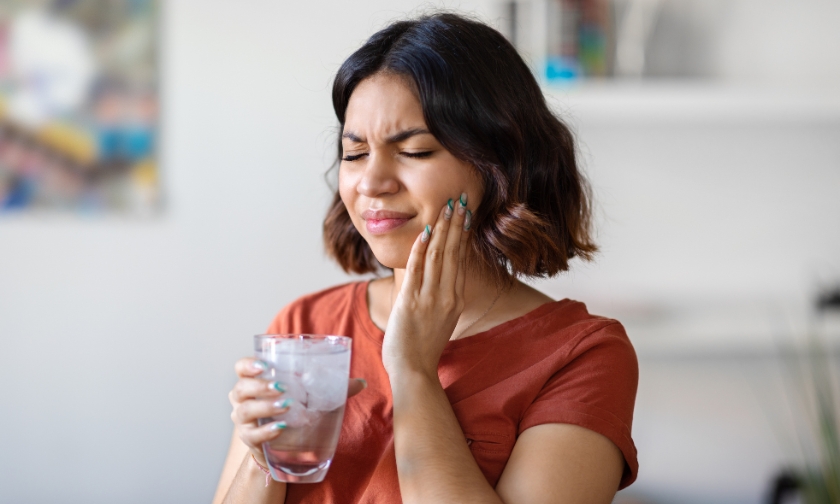
That unusual, unkind pain when you sip your morning coffee or the jolt you feel biting into something cold isn’t something you should just get used to. Tooth sensitivity is one of the most common dental complaints, but it’s also one of the most frequently ignored. People chalk it up to aging or assume it’s just how their teeth are now. Often, though, there’s a treatable reason behind it.
Dr. Davidson at Newton Dental Studio sees this regularly. And as a dentist near Newton, KS, and the surrounding Harvey County area, the approach here is always the same: find out what’s actually going on before recommending anything. Sensitivity is a symptom, and symptoms point to causes.
What’s Happening Inside a Sensitive Tooth
To understand why teeth become sensitive, it helps to know a little about their structure. The outer layer, enamel, is the hardest tissue in the human body. Beneath it sits dentin, a porous layer full of tiny tubules that lead toward the tooth’s nerve. When enamel wears down or gum tissue recedes, those tubules become exposed. Temperature changes, sweet foods, and even cold air can travel through them and trigger a pain response.
That’s the basic mechanism. What drives it varies widely from person to person, which is exactly why sensitivity shouldn’t just be masked with desensitizing toothpaste and forgotten. If you have this, get checked by the best dentist in Newton, KS.
Common Causes Worth Knowing
Enamel Erosion
Acidic foods and drinks are a leading culprit. Citrus fruits, sodas, sports drinks, and even certain vinegar-based foods gradually soften and thin the enamel surface. Over time, that thinning exposes the underlying dentin. Acid reflux delivers stomach acid directly to the tooth surface and accelerates the same process from the inside.
Gum Recession
When gum tissue pulls away from the tooth, the root surface becomes exposed. Unlike enamel-covered crowns, tooth roots have no protective outer layer – they connect directly to dentin. Recession can result from aggressive brushing, periodontal disease, or simply genetics. Either way, the exposed root is far more sensitive to temperature and pressure than the rest of the tooth. You can seek online a ‘dentist near me’ to find a reliable boutique dental studio in Newton.
Teeth Grinding (Bruxism)
Many people grind their teeth during sleep without knowing it. Over months and years, that repetitive force wears down enamel on the biting surfaces. The result is not just sensitivity but also increased fracture risk. If you wake up with jaw soreness, headaches, or notice your teeth looking flatter than they used to, bruxism may be contributing to what you’re feeling.
A Cracked Tooth
Hairline cracks in a tooth can be invisible to the naked eye but acutely painful. A crack allows temperature and pressure to reach the nerve in ways that intact enamel wouldn’t permit. This type of sensitivity is often caused by biting down on food at a certain angle, for example. It warrants prompt evaluation because small cracks can deepen.
Recent Dental Work
Some post-treatment sensitivity is completely normal and temporary. After fillings, crowns, or deep cleanings, teeth can remain reactive for a few weeks as the tissue settles. If sensitivity persists beyond that window or intensifies, it’s worth checking in with your dental team.
What Helps and What Doesn’t
Desensitizing toothpastes work by blocking the dentinal tubules or interfering with nerve signal transmission. They can meaningfully reduce day-to-day discomfort, but they don’t address the underlying cause. Think of them as management tools, not solutions.
What actually produces lasting relief depends on the root cause:
- Enamel erosion: Modifying the diet, treating reflux, and applying fluoride varnish in-office to strengthen remaining enamel
- Gum recession: Depending on severity, treatment ranges from improved brushing technique and a soft-bristle toothbrush to gum grafting for extensive cases
- Bruxism: A custom nightguard distributes bite force evenly and prevents further enamel wear — far more effective than over-the-counter options
- Cracked tooth: Evaluation determines whether a crown, bonding, or, in severe cases, extraction is the right approach
- Post-treatment sensitivity: Usually resolves on its own, but follow-up imaging can confirm nothing further is needed
Modern dentistry has come a long way in treating sensitivity without discomfort. At Newton Dental Studio, comfort options are a genuine part of the conversation – not an afterthought. Patients who’ve put off addressing sensitivity because they’re anxious about dental visits often find the process far less daunting than expected.
Sensitivity Is a Signal – Don’t Keep Ignoring It
Tooth sensitivity that’s getting worse, affecting multiple teeth, or disrupting your daily life deserves a proper look. If you’re searching for a ‘gentle dentist near me’ while residing in Newton who takes the time to get to the bottom of things, Dr. Davidson and the team at Newton Dental Studio are ready to help.
Book your appointment online or call the office directly. Relief is closer than you think – and it starts with finding out what’s actually going on.